Beyond HR
Leadership
Your first manager breaks the org chart
Google measured it and Gallup keeps measuring it: the quality of your first managers decides more about your company than the org chart does.
Team Inflection · October 2, 2026 · 4 min read
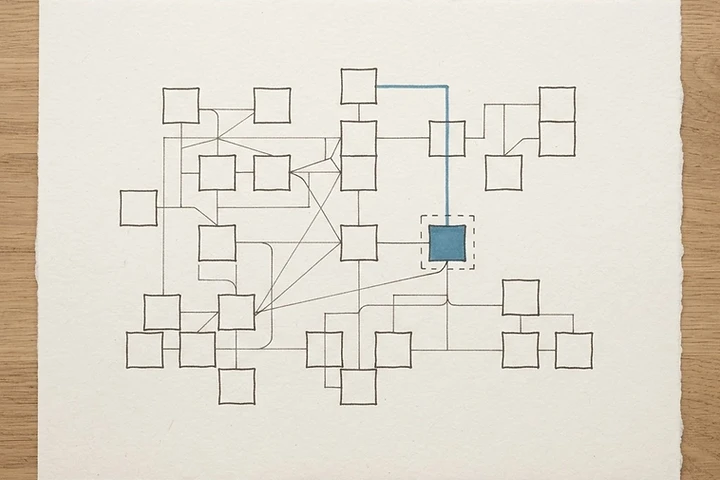
Two people, one job. The founder still does onboarding, the new manager owns it on paper, and both are surprised when the same decision gets made twice. Nobody planned the overlap; it appeared the week the first manager joined.
What the research says about managers
Google's Project Oxygen began as an internal argument about whether managers matter at all. The team analysed performance and feedback data and found that the quality of management was a stronger driver of team outcomes than individual technical expertise. It became one of the most cited internal people projects of the last two decades (published as a Harvard Business School case by Garvin, Wagonfeld and Kind, 2013) and produced a short list of manager behaviours — coaching, empowerment and caring about wellbeing among them.
Gallup's engagement research points the same way: managers account for at least 70% of the variance in engagement scores between teams. In a company of twenty-five that is not a statistic about someone else. One badly defined role in your first management layer is a measurable share of your company's mood.
What actually breaks
It is rarely the person. Three things break at once:
Ownership becomes ambiguous. The role was described in tasks instead of accountability. Nobody notices until the work is done twice, or not at all.
Memory replaces the record. Each manager keeps their own version of the last six months. Two versions mean two conversations.
Assessment turns into perception. With no scorecard and no history, the review becomes a contest about who tells the better story in the room.
What to do in the next two weeks
Write the role down before you judge the person: outcomes, decision rights, boundaries, and what success looks like in two quarters. Do it with the manager, not about them — the overlap with the founder's own work usually becomes visible in the first ten minutes of that conversation. Defining roles and responsibilities in a small team is really this one conversation per seat; role clarity for teams is either won or quietly lost in it.
Then start a record. One short note after a project or a one-to-one is enough. Its purpose is not surveillance; it is to make the next conversation defensible and to give every manager the same facts.
Finally, calibrate with the founder in the room. Not to grade the manager — to compare what the two of you believe the role expects. Disagreement about the role, rather than about the person, is what you are looking for.
Sources
- 1.Google's Project Oxygen: Do Managers Matter? — David Garvin, Alison Wagonfeld & Liz Kind, Harvard Business School case, 2013
- 2.State of the Global Workplace — Gallup, 2023
Beyond HR · Keep reading
Want this in your company, not just on a page?
Team Inflection turns these four rules into a tool your managers actually use: role scorecards, a real history, guided ABCD audits and a talent pipeline.
Join the beta waitlist